

Image Details
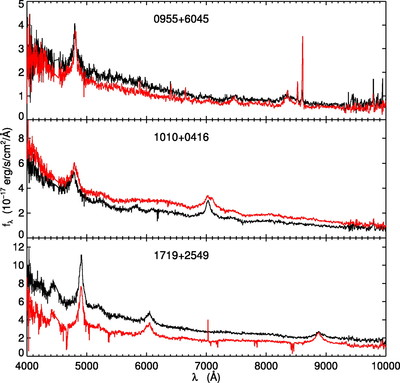
Caption: Fig. 4.
Keck ESI spectra of both members of three binary quasars. The top panel shows the binary SDSS J0955+6045 (﹩z=0.72﹩, ﹩\Delta \theta =18\farcs 6﹩, ﹩R_{\mathrm{prop}\,}=95.5\ h^{-1}\ \mathrm{kpc}\,﹩), the middle panel shows SDSS J1010+0416 (﹩z=1.51﹩, ﹩\Delta \theta =17\farcs 2﹩, ﹩R_{\mathrm{prop}\,}=104.3\ h^{-1}\ \mathrm{kpc}\,﹩), and the bottom panel shows SDSS J1719+2549 (﹩z=2.17﹩, ﹩\Delta \theta =14\farcs 7﹩, ﹩R_{\mathrm{prop}\,}=87.5\ h^{-1}\ \mathrm{kpc}\,﹩). The discontinuity in the spectra at 4500 Å is an artifact of a gap in the echelle orders. The ESI has a dispersion of 0.15–0.3 Å pixel−1 over a wavelength range of 4000–10500 Å.
Other Images in This Article
Show More
Copyright and Terms & Conditions
© 2006. The American Astronomical Society. All rights reserved. Printed in U.S.A.

