

Image Details
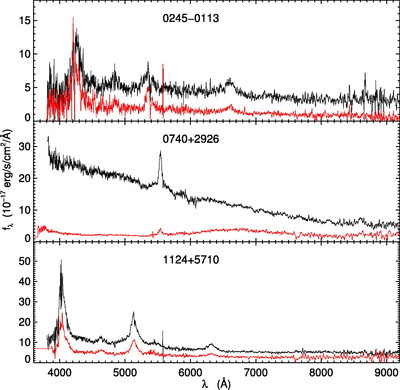
Caption: Fig. 6.
SDSS and APO spectra of both members of three binary quasars. The top panel shows the binary SDSS J0245−0113 (﹩z=2.46﹩, ﹩\Delta \theta =4\farcs 5﹩, ﹩R_{\mathrm{prop}\,}=26.3\ h^{-1}\ \mathrm{kpc}\,﹩), the middle panel shows SDSS J0740+2926 (﹩z=0.98﹩, ﹩\Delta \theta =2\farcs 6﹩, ﹩R_{\mathrm{prop}\,}=15.0\ h^{-1}\ \mathrm{kpc}\,﹩), and the bottom panel shows SDSS J1124+5710 (﹩z=2.31﹩, ﹩\Delta \theta =2\farcs 2﹩, ﹩R_{\mathrm{prop}\,}=12.7\ h^{-1}\ \mathrm{kpc}\,﹩). The binary in the top panel was a member of our overlap sample; hence, both quasars have SDSS spectra. For both the middle and bottom panels, the black curves are SDSS spectra of the brighter quasar in the pair, and the red curves are the APO spectra of the fainter companions. The absorption feature at 7600 Å in the lower two spectra is telluric. Although all three of these binaries have separations ﹩\Delta \theta \lesssim 5^{\prime \prime }﹩ characteristic of gravitational lenses, deep optical and near‐IR imaging show no lenses in the foreground.
Other Images in This Article
Show More
Copyright and Terms & Conditions
© 2006. The American Astronomical Society. All rights reserved. Printed in U.S.A.

