

Image Details
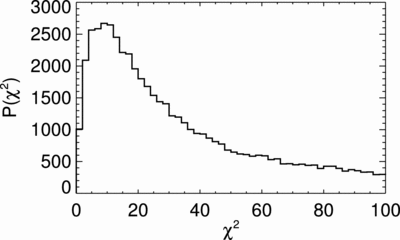
Caption: Fig. 1.
Histogram of the χ2 color similarity statistic (see eq. [2]) values for 64,621 unique pair combinations of 359 quasars in the SDSS sample in the narrow redshift interval ﹩2.4< z< 2.45﹩. Although the quasars are all at nearly the same redshift, ﹩z\simeq 2.4﹩, the dispersion in the color‐redshift relation of quasars (Richards et al. 2001a) results in a broad distribution. The median value is 33.1, so that a quasar pair survey that aims to achieve 50% completeness for ﹩z\simeq 2.4﹩ quasars would have to observe all quasar pair candidates with ﹩\chi ^{2}< 33.1﹩.
Other Images in This Article
Show More
Copyright and Terms & Conditions
© 2006. The American Astronomical Society. All rights reserved. Printed in U.S.A.

Copyright ©
2026 Astronomy Image Explorer. All Rights Reserved.
