

Image Details
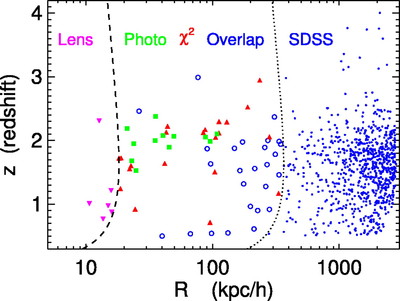
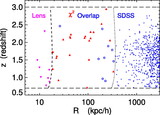
Caption: Fig. 3.
Range of redshifts and proper transverse separations probed by the binary quasars published in this work (see Tables 2–5). The blue dots show binary quasars identified in the SDSS spectroscopic sample. The region to the left of the dotted curve is excluded because of fiber collisions (﹩\theta < 60^{\prime \prime }﹩), with the exception of the binaries discovered from overlapping plates, which are indicated by the larger open blue circles. The magenta triangles show members of the lens sample, the red triangles are from the χ2 sample, and the green squares show binaries from the photometric sample. Because of the fiber collisions, the vast majority of small‐separation (﹩R\lesssim 300\ h^{-1}\ \mathrm{kpc}\,﹩) pairs were discovered from our follow‐up observations. The dashed curve indicates the transverse separation corresponding to ﹩\theta =3^{\prime \prime }﹩ below which binaries are found with our lens algorithm. Although we publish only pairs with separations ﹩R_{\mathrm{prop}\,}< 1\ h^{-1}\ \mathrm{Mpc}\,﹩ in this work, Fig. 3 shows all pairs in the SDSS + 2QZ catalog out to 3 h−1 Mpc for the sake of illustration.
Other Images in This Article
Show More
Copyright and Terms & Conditions
© 2006. The American Astronomical Society. All rights reserved. Printed in U.S.A.

Copyright ©
2026 Astronomy Image Explorer. All Rights Reserved.
