

Image Details
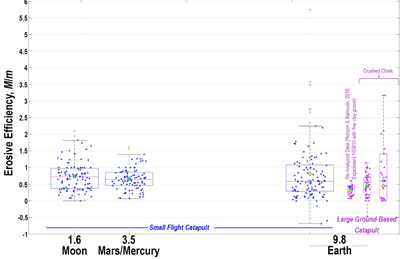
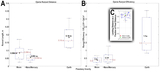
Caption: Figure 7.
Erosive efficiency as a function of gravity. Results for the small, flight-based catapult are in blue data points, and results from the large ground-based catapult are in magenta data points. As indicated, one set of large catapult results is reanalyzed from K. D. Runyon & O. S. Barnouin (2018). There is significant overlap between the interquartile ranges of all three gravity levels and between the small flight catapult and the large ground-based catapult. Negative erosive efficiency corresponds to thickening regolith due to up-range bulldozing even as ejecta is still deposited on top. (The box-and-whisker plot shows the middle 50% of data (i.e., the interquartile range from the 25th–75th percentiles), the whiskers show the data range less the outliers, and the furthest outliers are shown in red +’s. The red lines and cyan squares denote the median, and the yellow diamonds denote the mean of each dataset. The x-axis is semiquantitative; horizontal data spread within a box is only to enhance readability and does not indicate a variation in x-axis value).
Other Images in This Article
Show More
Copyright and Terms & Conditions
© 2026. The Author(s). Published by the American Astronomical Society.

