

Image Details
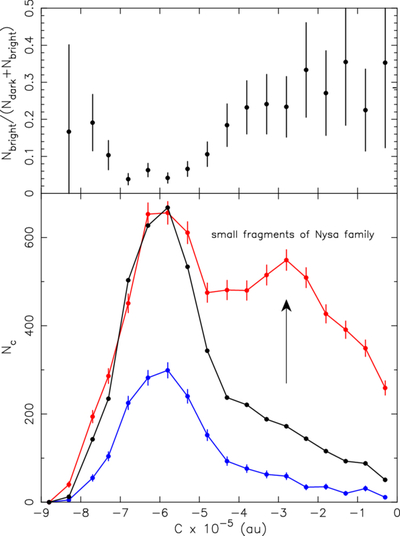
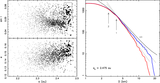
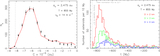
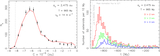
Caption: Figure 13.
Top panel: fraction f of bright asteroids (pV > 0.125) in C bins, bin size 5 × 10⁻⁶ au and center ac = 2.475 au, in the zone of the canonical Eulalia family introduced in Section 3.2. We use a sample of 244 bright and 1784 dark objects observed by WISE with H ≤ 16.0 and H ≤ 17.6, respectively (see the left and middle panels in Figure 12). The magnitude limits make the two samples correspond to the same size limit of ≃1.7 km for the respective median albedo value in the bright and dark categories. Bottom panel: blue and red data show the C-distribution of H ≤ 17.6 magnitude objects in the C⋆ limit of the canonical Eulalia family: (i) blue for WISE-observed dark objects (constituting the Eulalia family itself, left panel in Figure 12), and (ii) red for all known asteroids (right panel in Figure 12). The black distribution has been computed using Equation (6) and F2 = 3.02, F1 = 2.3 and f values inferred from data in the top panel individual to each of the bins. We postulate that the excess of the total asteroid population in the ∣C∣ < 4 × 10⁻⁵ au bins is due to an interloping population of small Nysa asteroids with H > 16.0 mag (see the middle and right panels of Figure 12).
Other Images in This Article
Show More
Copyright and Terms & Conditions
© 2026. The Author(s). Published by the American Astronomical Society.

