

Image Details
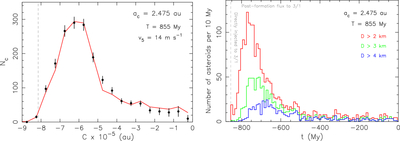
Caption: Figure 8.
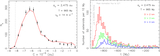
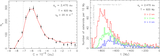
Modeling the dynamical evolution of the canonical Eulalia family with the center ac = 2.475 au. This solution used the bulk density ρ = 1.3 g cm−3, the surface thermal inertia Γ = 230 SI units, and the variable YORP timescale τ0 = 1 My. The best match to the data (left panel) is obtained for T = 855 My and v5 = 14 m s−1 (recall that the characteristic initial ejection velocity is vej(D) = v5 (5 km/D) in meters per second). This solution provides fewer fragments directly injected into the J3:1. Most of the flux into the resonance is due to post-formation transport of fragments by the Yarkovsky effect (right panel). The total number of transported D ≃ 2–3 km fragments to J3:1 is about 75% of that provided by the solution shown in Figure 7. Both ordinates are calibrated to the adopted family identification without correcting for its incompleteness.
Other Images in This Article
Show More
Copyright and Terms & Conditions
© 2026. The Author(s). Published by the American Astronomical Society.

