

Image Details
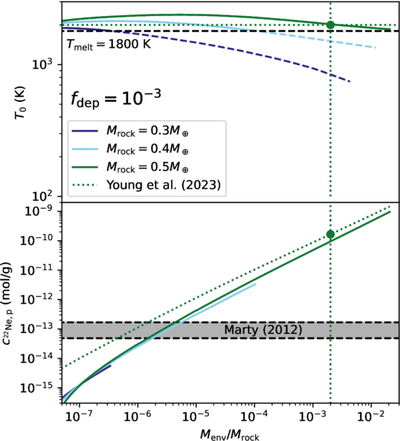
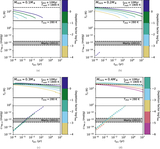
Caption: Figure 10.
Surface temperature T0 (upper panel) between the basaltic mantle of Earth embryos and primordial gas envelopes, along with the resulting concentration of primordial neon ﹩{c}_{{}^{22}{\rm{Ne}},{\rm{p}}}﹩ dissolved in the mantle (lower panel), both as functions of Menv/Mrock. We compare the input atmospheric parameters and the resulting dissolved neon content (given by Equation (12)) of the solution reported by the thermodynamic model of E. D. Young et al. (2023; dots and dotted curves) with our results for a rocky interior of masses Mrock = [0.3, 0.4, 0.5] M⊕ in blue, cyan, and green, respectively. The embryos are embedded in an MMSN of gas density depleted by a factor fdep = 10−3 (see Equation (8)). Volatiles are only dissolved in the presence of surface magma oceans (solid curves), that is, when T0 is greater than the melting temperature of the silicate mantle Tmelt ≈ 1800 K (Section 3.2), displayed with a black dashed curve. Once the surface of the mantle solidifies (colored dashed curves), atmospheric volatiles no longer dissolve in the solid surface of the rocky interior. We only show envelope masses corresponding to tacc ≲ 10 Myr, before the envelope growth is cut short by the dispersal of the disk. The target concentration of primordial neon required to explain the measurements of B. Marty (2012) is shown with a gray shaded band.
Other Images in This Article
Copyright and Terms & Conditions
© 2026. The Author(s). Published by the American Astronomical Society.

