

Image Details
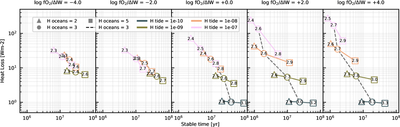
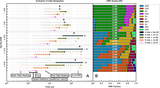
Caption: Figure 6.
Net atmospheric energy flux to space during GRE vs. onset time of the GRE epoch [yr]. Numbers show corresponding ﹩{\mathrm{log}}_{10}﹩ total surface pressure [bar]. Increasing hydrogen abundance reduces radiative cooling to space, extending low melt fraction magma ocean lifetimes and postponing GRE epochs. Tidal dissipation within the mantle is the dominant source of atmospheric heat fluxes in the majority of these scenarios. At large Htide, one can consider the tidal and total heat fluxes to be equivalent; for the weakest-heating case of Htide = 10−10, the tidal dissipation contributes 80% of the total heat flux. The remaining 20% comes from radiogenic heating.
Other Images in This Article
Copyright and Terms & Conditions
© 2026. The Author(s). Published by the American Astronomical Society.

