

Image Details
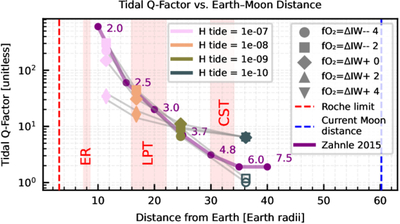
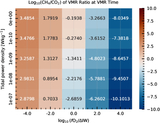
Caption: Figure 8.
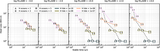
The distance to the Moon and the tidal dissipation parameter Q of the Earth after a canonical Moon-forming impact. Using Equation (6), the tidal Q parameters (efficiency of tides) corresponding to the individual simulations are calculated, subsequently Equation (10) is used to estimate the lunar orbital recession at the tidal power densities corresponding to the Q-parameters. Data points for fO2 = ΔIW − 2 and fO2 = ΔIW − 4 at tidal power densities =10−10 W kg−1 are linearly extrapolated from other data points in the figure (see the data reduction code in the Data Availability), as these cases solidified before tidal heating exceeded >0.1 W m−2. The purple lines shows the tidal Q parameter evolution found by K. J. Zahnle et al. (2015), with times in megayears after the Moon-forming impact. The red regions show the evection resonance (ER; J. Touma & J. Wisdom 1998), Laplace plane transition (LPT; S. Tremaine et al. 2009), and Cassini state transition (CST; S. J. Peale 1969).
Other Images in This Article
Copyright and Terms & Conditions
© 2026. The Author(s). Published by the American Astronomical Society.

