

Image Details
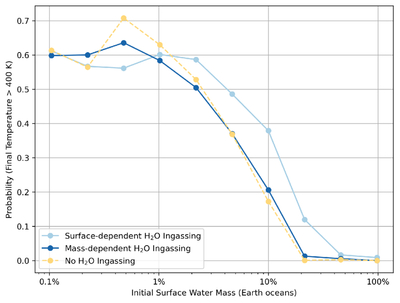
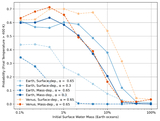
Caption: Figure 6.
The probability of reaching a final surface temperature above 400 K for different initial surface water inventories at Earth-like instellation and hypsometry. Monte Carlo runs are divided into 10 evenly space logarithmic bins based on their initial surface water, ranging from 0.1%–100% of Earth ocean mass (1.4 · 1018–1.4 · 1021 kg). The bin center is calculated using the geometric mean of its edges. Lower probabilities correspond to more habitable conditions, as they are less likely to exceed the habitable temperature threshold of 400 K where proteins begin to denature (A. Clarke 2014). Surface- and mass-dependent parameterizations of the deep-water cycle are shown for an Earth-like planet (instellation, hypsometry) with α = 0.3 (blue lines). Additionally, we include a third end-member where water ingassing is zero (“no ingassing,” yellow line) meaning no water is transferred from the surface to the interior. The mass-dependent case is more likely to be habitable at lower initial water inventories, with ∼15% of an Earth ocean marking the transition between a balanced and imbalanced carbon cycle evolution.
Other Images in This Article
Show More
Copyright and Terms & Conditions
© 2026. The Author(s). Published by the American Astronomical Society.

