

Image Details
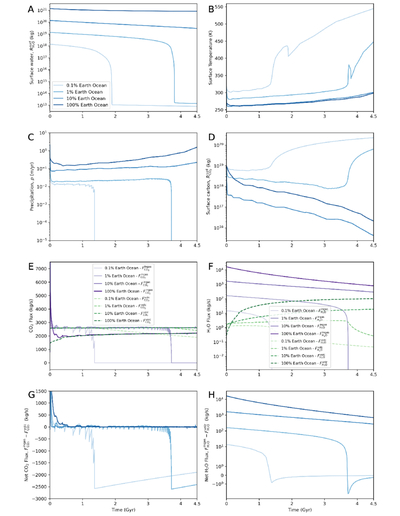
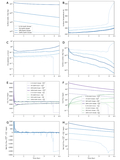
Caption: Figure 3.
Four model outputs with varying initial water inventories denoted by blue shading. These outputs use a mass-dependent deep-water cycle, an albedo (α) of 0.3, and escape processes are included. (A) Mass of all surface water reservoirs over the planet’s 4.5 Gyr evolution. (B) Surface temperature. (C) Precipitation calculated from wind-driven evaporation. (D) Mass of all surface CO2 including atmospheric CO2 and dissolved carbon. The ingassing fluxes of CO2 (E) and H2O (F) for various initial water inventories are denoted by purple shading. Outgassing fluxes of CO2 (E) and H2O (F) are denoted by dotted green shading. (G) Net CO2 flux into the interior. (H) Net H2O flux into the interior. In model runs with larger (10%, 100% of Earth’s oceans) water inventories, surface temperatures are temperate through geologic time, but model runs with low initial water show runaway warming. Smaller (0.1%, 0.01% of Earth’s oceans) initial water inventories have an unbalanced carbon cycle, increasing the flux of surface water into the interior while suppressing H2O outgassing. With less surface water, precipitation rates decrease (C), and silicate weathering fluxes become runoff limited, allowing volcanic outgassing to dominate (E). This results in surface warming (B) and increased concentrations of atmospheric CO2 (D).
Other Images in This Article
Show More
Copyright and Terms & Conditions
© 2026. The Author(s). Published by the American Astronomical Society.

