

Image Details
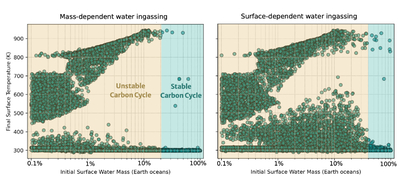
Caption: Figure 5.
Planetary surface temperatures after 4.5 Gyr of model evolution as a function of the initial water inventory for Earth-like planets with α = 0.3. Each dot represents the final surface temperature from our carbon cycle evolution model where we have performed a Monte Carlo calculation that randomly samples the initial surface and interior water mass, total carbon inventory, initial carbon partitioning between the surface and interior, soil age, temperature dependence of weathering, and several outgassing parameters. Parameter ranges are shown in Table 2. Yellow shading indicates the approximate region of initial water inventories where a greater percentage of model runs ends with uninhabitable surface temperatures resulting from an imbalanced carbon cycle. Cyan shading denotes the region where most model runs end with habitable surface temperatures and maintain a balanced carbon cycle. For planets of Earth-like mass, hypsometry, and instellations, those with a mass-dependent deep-water cycle require less water to maintain a balanced carbon cycle (20% of Earth’s oceans) compared to a surface-dependent parameterization (∼50% of Earth’s oceans).
Other Images in This Article
Show More
Copyright and Terms & Conditions
© 2026. The Author(s). Published by the American Astronomical Society.

