

Image Details
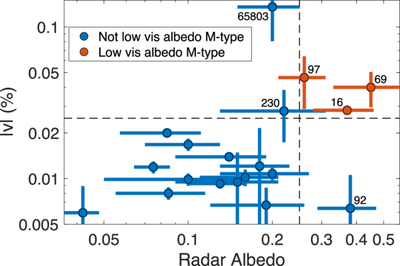
Caption: Figure 9.
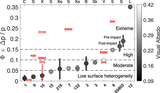
Lick 3 m POLISH2 observations of absolute fractional, optical circular polarization ∣v∣ as a function of S- or X-band radar albedo. Low visible albedo, M-type asteroids (red points) have both high radar albedo and high optical circular polarization. We detect a clear correlation between circular polarization and radar albedo except for two cases. The circularly unpolarized (92) Undina appears to be a rare M-type asteroid with high visual and radar albedos, and it is possible that (65803) Didymos’s circular polarization is contaminated by potentially bright, multiply scattering ejecta from the DART impact, or it may be a consequence of its observation at high phase angle. We propose that metalliferous bodies may be identified by absolute fractional circular polarization ∣v∣ > 0.025% = 250 ppm and radar albedo ﹩{\hat{\sigma }}_{\mathrm{OC}}\gt 0.25﹩ (dashed horizontal and vertical lines, respectively). The relatively large circular polarization of (230) Athamantis must be verified owing to its short, 22-minute observation.
Other Images in This Article
Copyright and Terms & Conditions
© 2026. The Author(s). Published by the American Astronomical Society.

