

Image Details
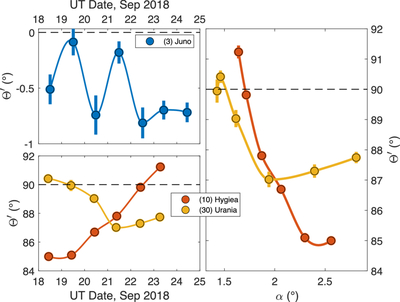
Caption: Figure 6.
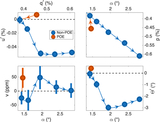
Variations in scattering-plane-referenced polarization orientation ﹩{{\rm{\Theta }}}^{{\prime} }﹩ observed on three asteroids during the UT 2018 September 18−25 Lick 3 m POLISH2 run. Note the change in ﹩{{\rm{\Theta }}}^{{\prime} }﹩ scale from object to object. Top left: ﹩{{\rm{\Theta }}}^{{\prime} }﹩ as a function of UT date for positive branch observations of (3) Juno obtained at ﹩25\,\mathop{.}\limits^{^\circ }2\lt \alpha \lt 26\,\mathop{.}\limits^{^\circ }4﹩ that modulate on its 7.2 hr rotation period (Figure 3). Bottom left: negative branch observations of (10) Hygiea and (30) Urania obtained for ﹩1\,\mathop{.}\limits^{^\circ }4\lt \alpha \lt 2\,\mathop{.}\limits^{^\circ }8﹩. Nightly uncertainties in ﹩{{\rm{\Theta }}}^{{\prime} }﹩ are typically ﹩{\sigma }_{{{\rm{\Theta }}}^{{\prime} }}\sim 0\,\mathop{.}\limits^{^\circ }1﹩ and significantly smaller than the size of the data points (Table 1). No change in POLISH2 mounting position occurred during the run, and all three asteroids exhibit either uncorrelated variations in ﹩{{\rm{\Theta }}}^{{\prime} }(t)﹩ ((3) Juno vs. the others) or anticorrelated variations ((10) Hygiea vs. (30) Urania) that must be intrinsic to each object. Right: Θ′(α), where the trends of (10) Hygiea vs. (30) Urania are correlated for α < 2°.
Other Images in This Article
Copyright and Terms & Conditions
© 2026. The Author(s). Published by the American Astronomical Society.

