

Image Details
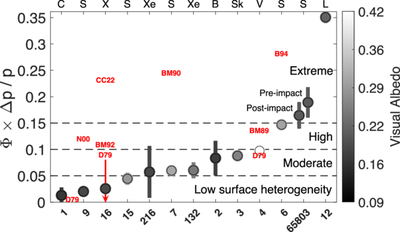
Caption: Figure 4.
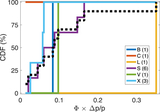
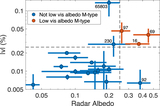
Airless bodies with POLISH2 detections of rotational polarization variations sorted by Φ × Δp/p (normalized peak-to-peak value of rotation-phase-locked linear polarization variations) into bins for low, medium, high, and extreme surface heterogeneity. Values of Δp/p are multiplied by the phase function Φ(α) at the time of observation to correct for the shadowed disk present at high phase angles. This reduces Δp/p and is only significant for (65803) Didymos at α ∼ 76°. Relative visual geometric albedo is shown by the grayscale shading of each data point, and taxonomic type is indicated at the top. Both quantities are obtained from the JPL Small-Body Database. No clear correlation between surface heterogeneity Δp/p and visual albedo exists. The extreme surface heterogeneity of (12) Victoria is unexpected. Our measurements of (65803) Didymos suggest that surface heterogeneity was higher before DART impact, which implies that heterogeneity may be higher for NEOs than for MBAs (see Section 2.2.1). Values and upper limits from the literature are labeled in red (J. Degewij et al. 1979; P. Broglia & A. Manara 1989, 1990, 1992; P. Broglia et al. 1994; H. Nakayama et al. 2000; J. H. Castro-Chacón et al. 2022), where all studies other than J. Degewij et al. (1979) report detections with significantly larger variations than we detect in this work.
Other Images in This Article
Copyright and Terms & Conditions
© 2026. The Author(s). Published by the American Astronomical Society.

