

Image Details
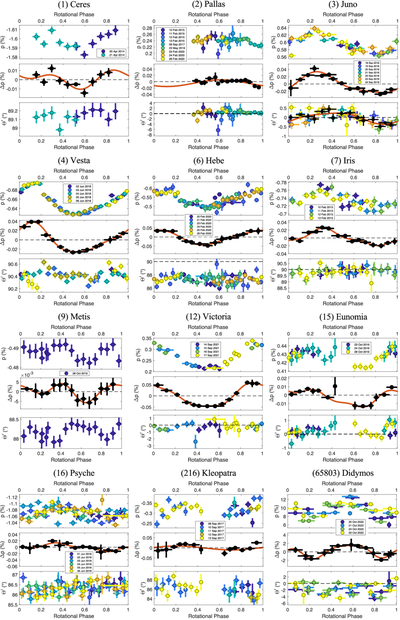
Caption: Figure 3.
Rotation-phase-locked measurements of airless bodies obtained with POLISH2 in an unfiltered, 383–720 nm bandpass at the Lick 1 m (for (1) Ceres) and Lick 3 m (all other bodies). Top panels: nightly fractional linear polarization p = P/I phased to known rotation period from the JPL Small-Body Database, where rotation phase = 0 is arbitrary. Absolute linear polarization ∣p∣ increases toward the top of each panel regardless of whether the object was observed on the positive or negative branch (Figure 1). Middle panels: phase-locked linear polarimetry binned in rotation phase. Best, third-order Fourier fits are shown as red curves. Bottom panels: linear polarization orientation ﹩{{\rm{\Theta }}}^{{\prime} }﹩ relative to the plane perpendicular to the Sun−body−observer scattering plane. For positive branch (Rayleigh-like) scattering, ﹩{{\rm{\Theta }}}^{{\prime} }=0^\circ ﹩, while ﹩{{\rm{\Theta }}}^{{\prime} }=\pm 90^\circ ﹩ for negative branch linear polarization. (3) Juno harbors rotational variations in ﹩{{\rm{\Theta }}}^{{\prime} }﹩ with >8σ confidence (binned data in black, with sinusoidal fit curve in red).
Other Images in This Article
Copyright and Terms & Conditions
© 2026. The Author(s). Published by the American Astronomical Society.

