

Image Details
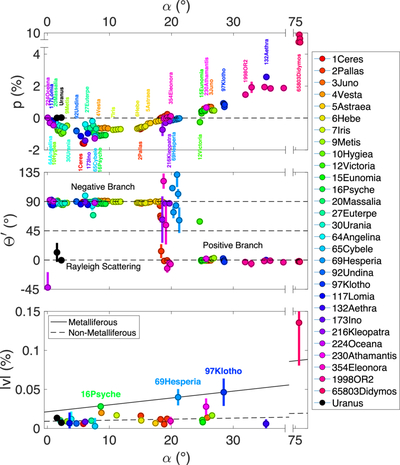
Caption: Figure 1.
Lick 3 m POLISH2 polarization phase curves of MBAs, NEOs (1998 OR2 and (65803) Didymos), and Uranus (control target). Lick 1 m POLISH2 observations of (1) Ceres are also shown. Note that the axis breaks to accommodate high phase angle observations of (65803) Didymos. Top: fractional linear polarization p = P/I is plotted against phase angle α, and linear polarization vanishes at the inversion angle α0 ∼ 20°. This angle is unique to each airless body and is tied to its mean surface index of refraction (K. Muinonen et al. 2002; J. Masiero et al. 2009; R. Gil-Hutton & E. García-Migani 2017). Fractional polarization is defined to be negative for α < α0 (“negative branch”) and positive for α > α0 (“positive branch”). Middle: polarization orientation ﹩{{\rm{\Theta }}}^{{\prime} }﹩ with respect to the plane perpendicular to the Sun−body−observer scattering plane. Here the inversion angle α0 ∼ 20° marks the discontinuity where polarization rapidly rotates by ﹩{\rm{\Delta }}{{\rm{\Theta }}}^{{\prime} }=\pm 90^\circ ﹩ from parallel to the scattering plane (for α < α0) to perpendicular to the scattering plane (Rayleigh-like, for α > α0). The control target Uranus displays Rayleigh-like polarization orientation, perpendicular to the scattering plane (﹩{{\rm{\Theta }}}^{{\rm{{\prime} }}}=0\mathop{.}\limits^{\unicode{x000b0}}39\pm 0\mathop{.}\limits^{\unicode{x000b0}}72﹩), even down to α = 1﹩\mathop{.}\limits^{\unicode{x000b0}}﹩6 owing to its gaseous atmosphere. Thus, airless and gaseous bodies may be immediately distinguished from each other at low α simply from their polarization orientation ﹩{{\rm{\Theta }}}^{{\prime} }﹩. Bottom: absolute value of fractional circular polarization ∣v∣ = ∣V∣/I vs. α, where the metalliferous (16) Psyche, (69) Hesperia, and (97) Klotho harbor elevated circular polarization (see Section 2.3.1). Linear fits to ∣v∣ vs. α are shown for both the metalliferous sample (solid line) and the nonmetalliferous sample (dashed line). The surface of the nonmetalliferous Didymos may be contaminated by material excavated from Dimorphos during the DART impact or may simply be a consequence of high phase angle observation.
Other Images in This Article
Copyright and Terms & Conditions
© 2026. The Author(s). Published by the American Astronomical Society.

