

Image Details
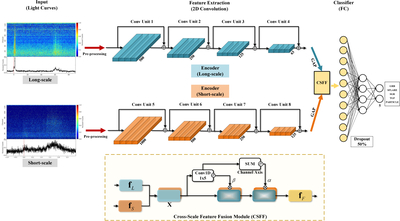
Caption: Figure 2.
Schematic of the proposed dual-scale neural network architecture for general trigger classification. The model processes input light curves through two parallel pathways: a long-scale encoder (blue) and a short-scale encoder (orange), each composed of four consecutive 2D convolutional units (Conv Units 1–4 and 5–8, respectively) for hierarchical feature extraction. The extracted feature vectors, fL and fS, are fed into the central CSFF. The zoomed-in view details the CSFF’s operation: a 1D convolutional layer models cross-scale interactions, generating attention maps which adaptively weight and combine fL and fS to produce a unified representation fF. This fused feature is aggregated via global average pooling (GAP) and finally classified by a fully connected (FC) layer with dropout. This end-to-end architecture enables the joint analysis of complementary temporal information.
Other Images in This Article
Copyright and Terms & Conditions
© 2026. The Author(s). Published by the American Astronomical Society.

