

Image Details
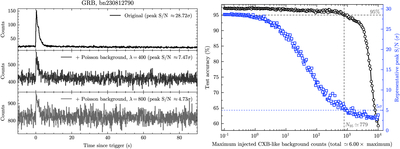
Caption: Figure 5.
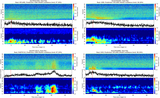
Robustness test under progressively reduced trigger significance. Left: representative long-scale light curves of GRB bn230812790 after injecting different levels of Poisson-distributed CXB-like background counts. The CXB-like spectrum is adopted because the cosmic X-ray background is a major diffuse component of the background in wide-field high-energy detectors. The original light curve has a peak S/N of ∼28.72σ, while the injected cases shown here have peak S/N values of ∼7.47σ and ∼4.73σ. Right: classification accuracy as a function of the maximum amplitude of the injected CXB-like Poisson background, ﹩{N}_{{\rm{inj}},{\rm{\max }}}﹩. Black circles show the test-set accuracy, while blue squares show the representative peak S/N of the example trigger under the same injection procedure. The gray horizontal dashed line marks 95% accuracy, and the gray vertical dashed line indicates N95 ≃ 779 (corresponding to total counts from 10 to 1000 keV of 4674), the injected background level at which the test accuracy first falls below 95%. The blue dashed line marks 5σ only as a reference for the representative trigger and is not used as a classification threshold.
Other Images in This Article
Copyright and Terms & Conditions
© 2026. The Author(s). Published by the American Astronomical Society.

