

Image Details
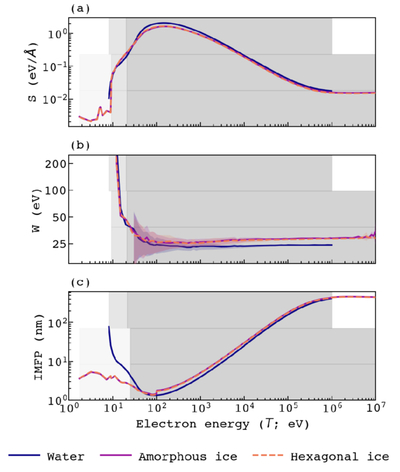
Caption: Figure 6.
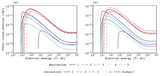
Geant4-IcyMoons benchmarks. (a) Electron stopping power in liquid water (G4EmDNAPhysics_option4) compared with amorphous and hexagonal ice. (b) Corresponding W-value (mean energy expended per ion pair), assuming bulk mass densities of 0.94 g cm−3 and 0.917 g cm−3 for amorphous and hexagonal ice, respectively (V. F. Petrenko & R. W. Whitworth 1999; M. Michaud et al. 2003; Z. Amato et al. 2026), with 1σ uncertainties shown in colored bands. (c) IMFP derived from all inelastic channels. The shaded background indicates the dominant inelastic channel in each energy range: vibrational excitation + dissociative (de)attachment (light), excitation (mid), and ionization (dark). The upper third shows water dominance, the middle third amorphous ice, and the lower third hexagonal ice. Sharp transitions in the bands indicate only a change in the channel whose contribution is largest.
Other Images in This Article
Show More
Copyright and Terms & Conditions
© 2026. The Author(s). Published by the American Astronomical Society.

