

Image Details
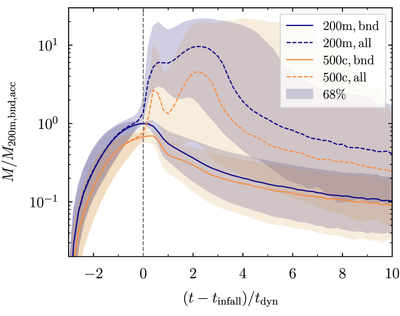
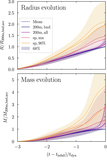
Caption: Figure 7.
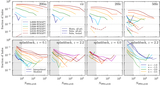
Mass evolution of subhalos before and after infall (left and right of vertical gray line). The lines show the median evolution of ﹩{M}_{200{\rm{m}}}﹩ (blue) and ﹩{M}_{500{\rm{c}}}﹩ (orange) in their bound-only (solid) and all-particle (dashed) versions, including only epochs where the respective mass could be measured. Time is measured in units of the dynamical time at infall. All masses are normalized to ﹩{M}_{200{\rm{m}},\mathrm{bnd}}﹩ at infall, so that the solid blue line is unity at ﹩{t}_{\mathrm{infall}}﹩ by construction. Before infall, the all-particle and bound-only masses grow in unison and with modest scatter in their evolution. Just before infall, the all-particle masses sweep up additional mass from the future host, including roughly 40% more mass on average for ﹩{M}_{200{\rm{m}}}﹩ and about 10% for ﹩{M}_{500{\rm{c}}}﹩. After infall, the bound-only mass begins to decrease whereas the all-particle mass rapidly grows. However, around one dynamical (or crossing) time, the mass decreases again as the subhalos reach their apocenter.
Other Images in This Article
Show More
Copyright and Terms & Conditions
© 2020. The American Astronomical Society. All rights reserved.

