

Image Details
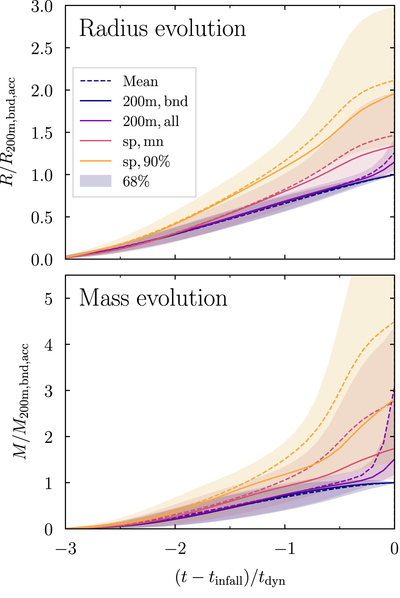
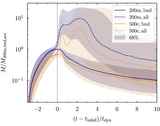
Caption: Figure 10.
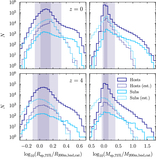
Evolution of SO and splashback radii (top) and masses (bottom) prior to infall into a larger halo. The figure corresponds to the left-hand side of Figure 7 for ﹩{M}_{200{\rm{m}},\mathrm{bnd}}﹩ and ﹩{M}_{200{\rm{m}},\mathrm{all}}﹩ (blue and purple lines), but we are not showing the evolution after infall because splashback radii are not physically meaningful for subhalos. The solid lines show the median evolution, the dashed lines the mean. For SO definitions such as ﹩{M}_{200{\rm{m}},\mathrm{all}}﹩, the inclusion of material belonging to the future host leads to a growth in both radius and mass. For the splashback definitions (red and orange lines), the situation is quite different: while the mean mass does grow significantly, the splashback radius follows a smooth trajectory that does not seem to be impacted much by the future merger.
Other Images in This Article

Show More
Copyright and Terms & Conditions
© 2020. The American Astronomical Society. All rights reserved.

