

Image Details
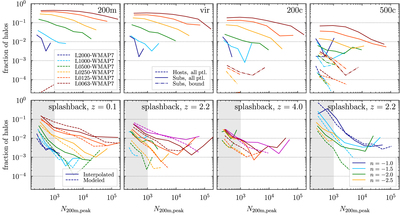
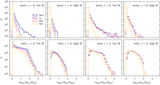
Caption: Figure 5.
Incompleteness of the catalogs as a function of the peak particle number. The colors refer to the different simulations in the WMAP7 sample, except in the bottom right panel, where they indicate the self-similar simulations. Top row: each panel shows an SO definition at z = 0.1. The lines show the fraction of halos for which an SO mass could not be computed, either because the threshold density was not reached at the center (common for high-density definitions such as ﹩{R}_{200{\rm{c}}}﹩) or because the density of the halo did not fall below the threshold even at large radii (common for low-density definitions such as ﹩{R}_{200{\rm{m}}}﹩). Ending lines mean that the corresponding fraction falls to zero. Dashed lines refer to all-particle masses for hosts, solid lines to all-particle masses for subhalos, and dotted–dashed lines to bound-only masses for subhalos. The all-particle definitions are frequently ill-defined for subhalos, leading to large incompleteness. The fractions depend on the box size because the small boxes contain more resolved subhalos whose strict SO masses would include the entire host halo. All-particle masses for hosts and bound-only masses for subhalos can almost always be computed, with the exception of a small fraction of halos in high-contrast definitions such as ﹩{R}_{500{\rm{c}}}﹩. The lines for bound-only host halos look very similar to the all-particle versions and are thus omitted. Bottom row: the panels show the completeness of the splashback definitions for host halos; all splashback definitions share the same status. Missing values are recovered by MORIA by either interpolating using adjacent snapshots (solid lines) or predicting a value from a fitting function (dashed lines). Both fractions are low, especially at ﹩N\gt 1000﹩, which is the suggested threshold for using the splashback data (gray area). At high redshift, the number of interpolated and modeled radii drops. The bottom right panel demonstrates that the completeness is somewhat worse in the self-similar simulations with shallow slopes, especially n = −1. See Section 5.2 for details.
Other Images in This Article
Show More
Copyright and Terms & Conditions
© 2020. The American Astronomical Society. All rights reserved.

