

Image Details
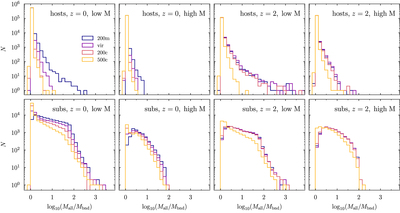
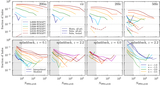
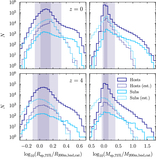
Caption: Figure 6.
Ratio of all-particle and bound-only SO masses for host halos (top row) and subhalos (bottom row), low and high redshift, and low and high masses (defined as ﹩0.5\lt \nu \lt 1﹩ and ﹩1.5\lt \nu \lt 2﹩). In each panel, the colored lines show histograms of the radius ratio for four mass definitions. Since ﹩M\propto {R}^{3}﹩ for SO definitions, the logarithmic differences in radius are three times smaller. For host halos, the definitions agree for the vast majority of halos, but there is a tail toward high ratios caused by halos that are close to another, larger halo. In such cases, the all-particle mass can encompass much or all of the other halo’s mass. As expected, this effect is more common for lower-threshold definitions such as ﹩{R}_{200{\rm{m}}}﹩, at low mass, and at high redshift. The all-particle masses of a large fraction of subhalos are ill-defined; the cutoff of the distribution around a ratio of 1000 is partly caused by SPARTA’s algorithm. The dependence on mass definition is even stronger for subhalos, with high-threshold definitions such as ﹩{R}_{500{\rm{c}}}﹩ performing better. However, high thresholds also lead to more subhalos for which no mass can be found at all, which are excluded from this figure. See Section 5.3 for details.
Other Images in This Article
Show More
Copyright and Terms & Conditions
© 2020. The American Astronomical Society. All rights reserved.

