

Image Details
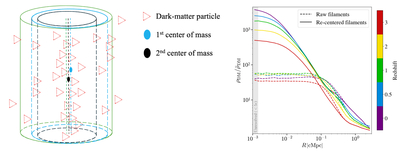
Caption: Figure 2.
Left: illustration of the method used to refine the spine location of a filament segment. The sequence of “shrinking cylinder” operations is indicated by the green, blue, and black cylinders. At the (k + 1)th iteration, the spine is repositioned to pass through the center of mass of particles enclosed within the cylindrical region of radius Rk from the kth iteration, after which the radius is reduced by 10%. The iteration terminates when the number of enclosed particles falls below 100 or when the spine displacement between successive steps becomes smaller than 1 ckpc. The allowed translations are restricted to directions perpendicular to the spine, i.e., rotations are not permitted. Right: radial DM density profiles around the raw (dashed) and recentered (solid) filaments at different redshifts. All profiles are length-weighted means over the corresponding filament samples and are normalized by the cosmic mean density. The radial range is limited to R < 3 cMpc in order to minimize the impact of profiles extending beyond the simulation boundaries. The gray shaded region marks unresolved scales, defined as distances to the filament spine smaller than 5 times the DM softening length of TNG50-1.
Other Images in This Article
Copyright and Terms & Conditions
© 2026. The Author(s). Published by the American Astronomical Society.

