

Image Details
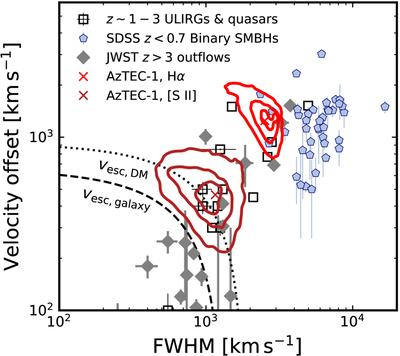
Caption: Figure 9.
Velocity offsets (∣Δv∣) and broad-component FWHM from rest-frame optical emission lines. Outflows at low redshift (black squares; C. M. Harrison et al. 2012; N. L. Zakamska et al. 2016) and high redshift (gray diamonds; J. Yang et al. 2023; S. Carniani et al. 2024; Y. Xu et al. 2025; W. Liu et al. 2026) are typically measured from [O III]. Binary-SMBH candidates at z < 0.7 (blue pentagons; M. Eracleous et al. 2012) are inferred from Hβ. AzTEC-1’s broad Hα (red) and broad [S II] (orange) are shown with contours spanning the 16th, 50th, and 84th percentiles of all models considered with an offset broad component. The measured velocities exceed the escape velocity of AzTEC-1’s galaxy (1010.5 M⊙ at 1 kpc, dashed) and dark-matter halo (1012 M⊙ at 10 kpc, dotted) above which the maximum gas velocity (∣Δv∣ + 0.5 × FWHM) would be unbound. All other outflows with ∣Δv∣ and FWHM exceeding 1000 km s−1 are extended over 2–15 kpc (C. M. Harrison et al. 2012). AzTEC-1’s broad Hα kinematics overlap the most extreme outflows in luminous z ≈ 5–6 quasars and SMBH-binary candidates selected from SDSS.
Other Images in This Article
Show More
Copyright and Terms & Conditions
© 2026. The Author(s). Published by the American Astronomical Society.

