

Image Details
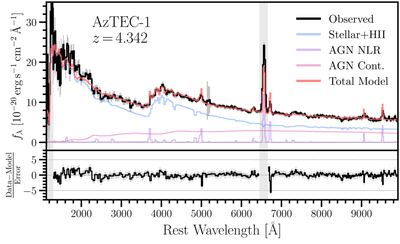
Caption: Figure 7.
Best-fit BEAGLE-AGN decomposition of AzTEC-1’s PRISM spectrum, which is used to infer a stellar mass and the star formation history. The model includes stellar+H2 region emission (blue), NLR emission (purple), and AGN continuum emission (magenta). The Hα+[N II] region is masked and these emission-line fluxes (measured from the G395M spectrum) are instead directly fitted using the “spectral indices” functionality. The best-fit model provides an excellent fit to the observed PRISM continuum, and narrow-component line fluxes are all reproduced within their observational uncertainties. Since BEAGLE-AGN currently does not model broad-line region emission, we exclude broad Hα emission from the fit, which is responsible for the visual mismatch between the model and observed Hα emission line. The fit prefers modestly attenuated (AV ≈ 1.5) stellar and AGN continuum emission, with most of the galaxy’s stellar mass having formed at a lookback time of ∼400−500 Myr.
Other Images in This Article
Show More
Copyright and Terms & Conditions
© 2026. The Author(s). Published by the American Astronomical Society.

