

Image Details
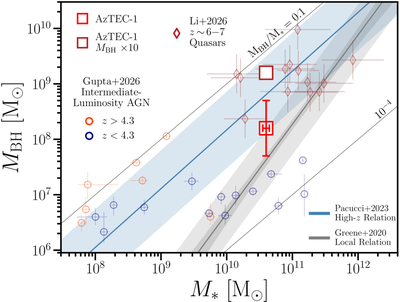
Caption: Figure 12.
Measured BH-mass to stellar-mass ratio for AzTEC-1’s companion SMBH (red square) compared to the local relation (gray shaded region; J. E. Greene et al. 2020) and JWST-observed AGN at z ≈ 4−7 (blue shaded region; F. Pacucci et al. 2023). If the active BH is in a near-equal-mass binary, then AzTEC-1 would be consistent with the local relation and may represent a source which previously had an elevated MBH/M* ratio but whose host galaxy rapidly assembled in the past ∼500 Myr. This transition may be echoed by the elevated MBH/M* ratios of JWST AGN above the redshift of AzTEC-1 (orange circles) compared to those at lower redshifts (blue circles). The maroon square represents the total binary mass in AzTEC-1 assuming an SMBH-binary mass ratio of q = 0.1; in this case, the MBH/M* ratio remains high, near z > 6 quasars (maroon diamonds; R. Li et al. 2026). It may be challenging to reconcile such a system with the local relation given the limited available gas budget (K. Tadaki et al. 2018), though such extreme sources do exist in the low-redshift universe (M. Mezcua et al. 2024).
Other Images in This Article
Show More
Copyright and Terms & Conditions
© 2026. The Author(s). Published by the American Astronomical Society.

