Image Details

Choose export citation format:

Toward Unbreaking the Universe: MINERVA Measurements of Color Gradients in Massive Quiescent Galaxies Can Help Ease Too-early Star Formation Tensions

  • Authors: Sam E. Cutler, Luke Robbins, Danilo Marchesini, Katherine A. Suess, Adam Muzzin, Gabriel Brammer, Yoshihisa Asada, Nicholas S. Martis, Stacey Alberts, Jacqueline Antwi-Danso, Aidan P. Cloonan, Ivo Labbé, Tim B. Miller, Ikki Mitsuhashi, Alexandra Pope, Anna Sajina, Ghassan T. E. Sarrouh, Monu Sharma, Mauro Stefanon, Edgar P. Vidal, Chris J. Willott, Rachel Bezanson, Maruša Bradač, Olivia R. Cooper, Robert Feldmann, Ben Forrest, Karl Glazebrook, Jenny E. Greene, Valentina La Torre, Jamie Lin, Michael V. Maseda, Ian McConachie, Themiya Nanayakkara, Gaël Noirot, Richard Pan, Kesha A. Patel, Veronica Pratt, Marcin Sawicki, David J. Setton, John R. Weaver, Arjen van der Wel, Katherine E. Whitaker, Yunchong Zhang, Kumail Zaidi

Sam E. Cutler et al 2026 The Astrophysical Journal Letters 1008 .

  • Provider: AAS Journals

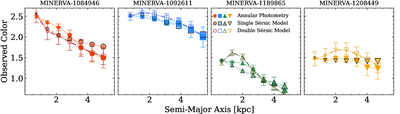
Caption: Figure A1.

Observed color gradients measured from aperture photometry are consistent with those extracted via forward-modeling techniques. Solid points show the color gradients derived from PSF-matched elliptical annuli, as shown in the top row of Figure 2. The filters used to compute the color gradients are also identical to those in Figure 2. The color gradients derived from single Sérsic profile fits using PYSERSIC (I. Pasha & T. B. Miller 2023) are shown with black-outlined points, while open points show gradients measured from a double Sérsic model.

Other Images in This Article
Copyright and Terms & Conditions

Additional terms of reuse