Image Details

Choose export citation format:

Toward Unbreaking the Universe: MINERVA Measurements of Color Gradients in Massive Quiescent Galaxies Can Help Ease Too-early Star Formation Tensions

  • Authors: Sam E. Cutler, Luke Robbins, Danilo Marchesini, Katherine A. Suess, Adam Muzzin, Gabriel Brammer, Yoshihisa Asada, Nicholas S. Martis, Stacey Alberts, Jacqueline Antwi-Danso, Aidan P. Cloonan, Ivo Labbé, Tim B. Miller, Ikki Mitsuhashi, Alexandra Pope, Anna Sajina, Ghassan T. E. Sarrouh, Monu Sharma, Mauro Stefanon, Edgar P. Vidal, Chris J. Willott, Rachel Bezanson, Maruša Bradač, Olivia R. Cooper, Robert Feldmann, Ben Forrest, Karl Glazebrook, Jenny E. Greene, Valentina La Torre, Jamie Lin, Michael V. Maseda, Ian McConachie, Themiya Nanayakkara, Gaël Noirot, Richard Pan, Kesha A. Patel, Veronica Pratt, Marcin Sawicki, David J. Setton, John R. Weaver, Arjen van der Wel, Katherine E. Whitaker, Yunchong Zhang, Kumail Zaidi

Sam E. Cutler et al 2026 The Astrophysical Journal Letters 1008 .

  • Provider: AAS Journals

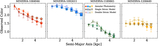
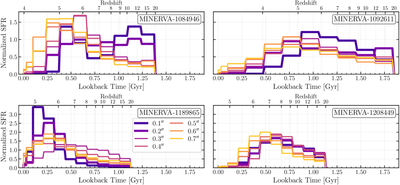
Caption: Figure 4.

Resolved, median SFHs from PROSPECTOR for the four C24 ultramassive quiescent galaxies. Colors indicate the corresponding annulus that was used to measure photometry and are identical to Figure 1. SFHs are normalized such that their integral is unity. In all galaxies except MINERVA-1189865, stellar populations in the outskirts form the bulk of their stars later on.

Other Images in This Article
Copyright and Terms & Conditions

Additional terms of reuse