

Image Details
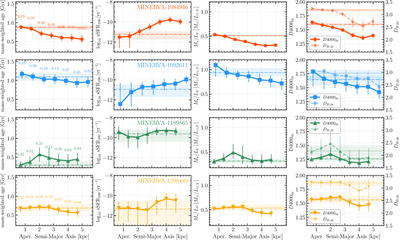
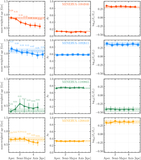
Caption: Figure 3.
The distribution of galaxy mass-weighted age, sSFR (averaged over the last 100 Myr of the galaxies’ SFHs), rest-frame V-band mass-to-light ratio, and dust-corrected (“de-reddened”) D4000 and DB (D4000dr and DB,dr) strengths in each annular aperture for our “fiducial” model, whereby the metallicity is given a strong Gaussian prior set by the values from C24, and a strong dust prior set by inferred global values from modeling including MIRI photometry. The fractions above the values in the mass-weighted age column indicate the relative amount of the total stellar mass contained within the corresponding annulus. Error bars indicate 1σ uncertainties. Dashed–dotted (dotted) lines and lightly shaded regions indicate the median mass-weighted age, sSFR, M⋆/LV, and D4000,dr (DB,dr) and their uncertainties as measured from fits to the slit photometry using our fiducial model.
Other Images in This Article
Copyright and Terms & Conditions
© 2026. The Author(s). Published by the American Astronomical Society.

