

Image Details
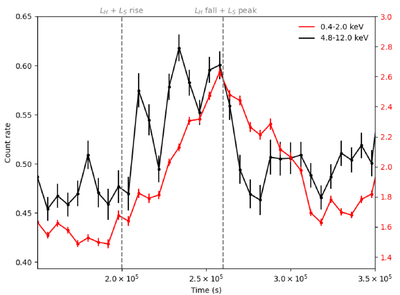
Caption: Figure 2.
XRISM/Xtend soft (red) and hard (black) LCs of NGC 3783 during the flare, binned to 6 ks time steps. Time shown starts with the XRISM observation. The beginning of the rise in luminosity in both bands at ∼2 × 10⁵ s and the sharp drop in hard X-ray at ∼2.6 × 10⁵ s as defined by L. Gu et al. (2025) are marked. The rise and fall of the hard X-rays are steeper than those of the soft X-rays, suggesting different emission mechanisms. We interpret the hard X-rays (LH) as originating from nonthermal electrons following a magnetic reconnection event, while soft X-rays (LS) are emitted in the alleged loop footprints. In the hard X-rays the 6.0–7.2 keV range is excluded as it contains strong emission and absorption lines unrelated to the Neupert effect.
Other Images in This Article
Copyright and Terms & Conditions
© 2026. The Author(s). Published by the American Astronomical Society.

