

Image Details
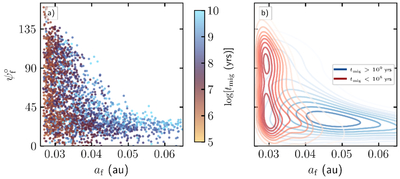
Caption: Figure 2.
Final semimajor axes and obliquities of HJs formed in our fiducial simulations. Panel (a): the final semimajor axes of HJs are shown on the x-axis, and the final obliquities are shown on the y-axis. The color indicates the migration timescale. Close-in HJs exhibit a broad range of obliquities, whereas wider-orbit HJs tend to have low obliquities. The distribution shows an envelope that constrains the maximum obliquity of HJs at a given final semimajor axis. Panel (b): kernel density estimates of fast- and slow-migrating HJs in af–ψf space. HJs that take longer to migrate tend to have lower obliquities and wider orbits, whereas rapidly migrating HJs tend to end up on close-in orbits with a broad range of obliquities.
Other Images in This Article
Copyright and Terms & Conditions
© 2026. The Author(s). Published by the American Astronomical Society.

