

Image Details
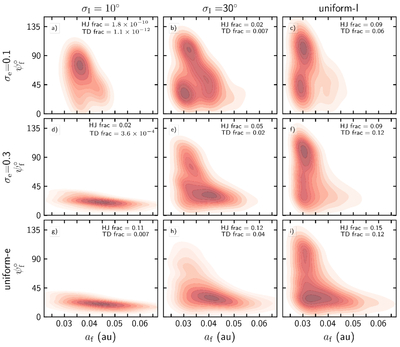
Caption: Figure 3.
Weighted distributions of the final semimajor axes and obliquities of HJs formed in our simulations. In our fiducial simulations, the initial eccentricities and mutual inclinations of the planets are sampled on a uniform grid. In this figure, we assign weights to each HJ to reflect different assumed underlying distributions of initial eccentricities and mutual inclinations. Specifically, we compute the weights using Rayleigh distributions with varying scale parameters, σ, as well as uniform distributions. The assumed distribution of initial eccentricities varies between rows, while the assumed distribution of initial mutual inclinations varies between columns. When the initial mutual-inclination distribution is strongly weighted toward low values, only CHEM is allowed. In contrast, when the initial mutual-inclination distribution is broad and the initial eccentricity distribution is weighted toward low values, the ZLK mechanism dominates. Sufficiently high initial eccentricities and mutual inclinations (σe > 0.3 and σI > 30°) are required to recover the semimajor-axis–obliquity correlation found in our fiducial simulations.
Other Images in This Article
Copyright and Terms & Conditions
© 2026. The Author(s). Published by the American Astronomical Society.

