

Image Details
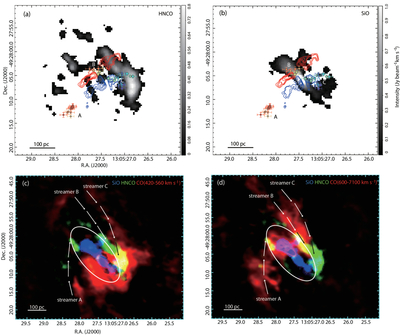
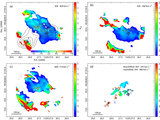
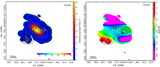
Caption: Figure 6.
Spatial correlation of other shock tracers with the molecular outflow and methanol masers in NGC 4945. Integrated intensity (moment 0) maps of two shock-tracing molecular lines observed with ALMA in the 3 mm band: HNCO (40,4−30,3) at 87.925 GH (panel (a)) and SiO(J = 2−1) at 86.847 GHz (panel (b)). The emission of these molecules is enhanced in regions affected by shocks. For context, the high-velocity molecular outflow is overlaid as red and blue contours (tracing the CO (J = 3−2) line wings, as defined in Figure 2). The distribution of the 36.2 GHz Class I methanol maser spots is also shown as colored circles (following the convention of Figure 2). Panels (c) and (d): Three-color composite images combining the emission from SiO (blue), HNCO (green), and CO (2–1; red) for the velocity ranges 420–560 km s−1 (panel (c)) and 600–710 km s−1 (panel (d)). Three distinct filamentary structures (labeled Streamers A, B, and C) extending from the nuclear region are indicated with arrows. A white ellipse outlines the circumnuclear molecular ring. The HNCO emission significantly traces the shocked interfaces between the three infalling streamers and the molecular ring.
Other Images in This Article
Copyright and Terms & Conditions
© 2026. The Author(s). Published by the American Astronomical Society.

