

Image Details
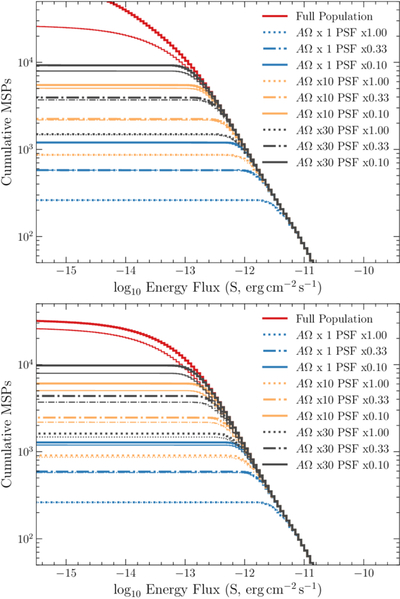
Caption: Figure 6.
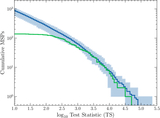
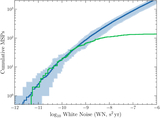
Distribution in energy flux for detected (TS > 100) MSPs in the disk+bulge population scenarios S2 and S3, and for the nine GeV-band concepts discussed in the text (heavier lines). Line colors and styles distinguish the nine concepts. The disk-only contributions, i.e., S1, are also shown (lighter lines). Top: In S2, the bulge population comprises 1.2 × 10⁵ MSPs from an AIC pathway, and it is evident that relatively few of these bulge pulsars are detectable. Bottom: In S3, the bulge population comprises 6700 MSPs, assumed to share the same γ-ray emission properties as the disk. Due to their higher individual γ-ray luminosity, these pulsars are more detectable, particularly by instruments with a good PSF.
Other Images in This Article
Copyright and Terms & Conditions
© 2026. The Author(s). Published by the American Astronomical Society.

