Image Details

Choose export citation format:

A Morphology Catalog of Galaxies in CEERS: Evolution in the Size and Color Gradients of Galaxies Since Cosmic Dawn

  • Authors: Elizabeth J. McGrath, Steven L. Finkelstein, Guillermo Barro, Viraj Pandya, Henry C. Ferguson, Jeyhan S. Kartaltepe, Dale D. Kocevski, Ricardo O. Amorín, Bren E. Backhaus, Fernando Buitrago, Antonello Calabrò, Yingjie Cheng, Luca Costantin, Isa G. Cox, Kelcey Davis, Giovanni Gandolfi, Yuchen Guo, Nimish P. Hathi, Michaela Hirschmann, Benne W. Holwerda, Marc Huertas-Company, Anton M. Koekemoer, Ray A. Lucas, Bahram Mobasher, Fabio Pacucci, Casey Papovich, Pablo G. Pérez-González, Jonathan R. Trump, L. Y. Aaron Yung, Pablo Arrabal Haro, Micaela B. Bagley, Mark Dickinson, Adriano Fontana, Andrea Grazian, Norman A. Grogin, Lisa J. Kewley, Allison Kirkpatrick, Jennifer M. Lotz, Laura Pentericci, Nor Pirzkal, Swara Ravindranath, Rachel S. Somerville, Stephen M. Wilkins, Guang Yang, Lise-Marie Seillé, Xin Wang

Elizabeth J. McGrath et al 2026 The Astrophysical Journal Letters 999 .

  • Provider: AAS Journals

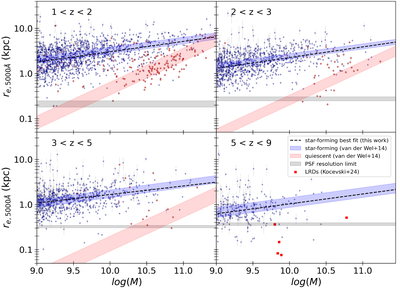
Caption: Figure 7.

Galaxy size as a function of mass in four redshift bins. Data points are color coded by their location in rest-frame UVJ color–color space (blue = star forming and red = quiescent). Shaded regions show the best-fit relations from A. van der Wel et al. (2014) extrapolated to each redshift range for star-forming and quiescent galaxies (blue and red, respectively). The dashed blue line in each plot is the best-fit linear relation for star-forming galaxies using the CEERS data. Some of the most compact sources at high z are identified as “Little Red Dots” (LRDs; D. D. Kocevski et al. 2025) and are excluded from the fit. The PSF resolution limit is shown as the horizontal gray shaded region for each redshift range.

Other Images in This Article
Copyright and Terms & Conditions

Additional terms of reuse