

Image Details
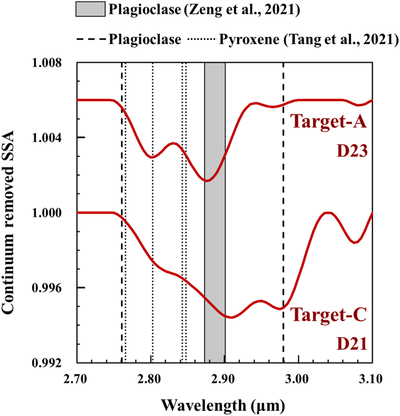
Caption: Figure 2.
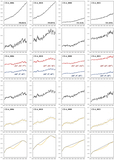
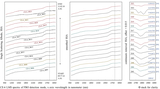
Type Ⅱ spectra and the potential host minerals of water (OH/H2O). The continuum-removed SSAs of Target-A D23 and Target-C D21 are shown as the red solid lines. According to the proton (H+) implantation experiments in the laboratory, new multiple absorption peaks occur in both the terrestrial plagioclase (dashed lines) and pyroxene (dotted lines; H. Tang et al. 2021). The gray area also corresponds to the peak centers of irradiated plagioclase, which varied with temperatures (20℃–100℃, turns to shorter wavelengths; X. Zeng et al. 2021). Target-C D21 was estimated with 33 ppm water content, so the spectral features are perhaps still influenced by a few adsorbed water molecules (H2O) and even some adsorbed hydroxyl (OH) on the solid surface of lunar mineral grains. When the water content further decreased to 26 ppm in Target-A D23, its spectral features may better represent the OH groups within lunar mineral crystal lattices.
Other Images in This Article
Copyright and Terms & Conditions
© 2026. The Author(s). Published by the American Astronomical Society.

