

Image Details
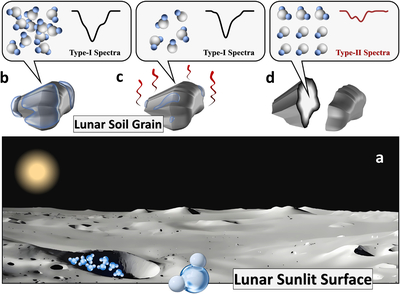
Caption: Figure 4.
Diverse species and inventories of water (OH/H2O) in thermal desorption on the Moon. (a) The lunar surface is heated by the Sun through electromagnetic wave radiation, approaching a quite high temperature (∼350 K) in the period of Chang’e-6 spectral observations close to lunar noon (10:00–11:00 a.m.). Driven by the harsh thermal environment, the H2O molecules adsorbed on the solid surface of lunar soil grains gradually ran out until they were nearly depleted, with only a few of them hiding in the shadow regions that can survive. The remnant water may consist of a few adsorbed OH and mainly the structural OH/H2O within soil grains. Given the relatively high thermal stability of the internal OH/H2O (X. Zeng et al. 2021; W. Yu et al. 2025), it may not lose too much even with a longer time or higher temperatures. (b) Adsorbed molecular water on the solid surface of lunar soil grains. These external H2O molecules are bound by van der Waals attractions and hydrogen bonds, corresponding to a single-peak absorption feature (Type I) near 3 μm in spectra. (c) A gradual decrease in adsorbed molecular water due to thermal desorption. The single-peak absorption feature shifts toward shorter wavelengths (2.9–2.8 μm) and becomes weaker over time. (d) Adsorbed molecular water exhausted. The spectral signal of the remanent water emerges, which is characterized as the multipeak absorption feature (Type Ⅱ), representing the internal structural OH/H2O within lunar soil grains/mineral crystal lattices.
Other Images in This Article
Copyright and Terms & Conditions
© 2026. The Author(s). Published by the American Astronomical Society.

