

Image Details
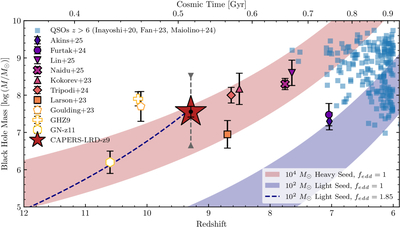
Caption: Figure 6.
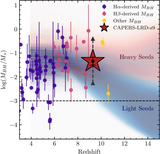
Redshifts and black hole masses of CAPERS-LRD-z9 (red star; canonical errors are shown in black, systematic upper and lower limits are shown in gray), populations of z ≳ 6 quasars (small blue points; K. Inayoshi et al. 2020; X. Fan et al. 2023; R. Maiolino et al. 2024), notable massive z > 6 spectroscopically confirmed BLAGN (filled symbols; V. Kokorev et al. 2023; R. L. Larson et al. 2023; L. J. Furtak et al. 2024; R. Tripodi et al. 2024; H. B. Akins et al. 2025a; X. Lin et al. 2025; R. P. Naidu et al. 2025), and the highest-redshift AGN detected through X-ray emission and high-ionization UV emission lines, respectively (open symbols; A. J. Bunker et al. 2023; A. D. Goulding et al. 2023; O. E. Kovács et al. 2024; L. Napolitano et al. 2024). We also show the growth of 102 M⊙ (blue shading) and 104 M⊙ (red shading) black hole seeds growing at the Eddington limit. We also show the growth track of a 102 M⊙ stellar remnant formed at z = 30 that starts accreting at 1.85× the Eddington limit 100 Myr after formation (dark blue dashed curve). CAPERS-LRD-z9’s black hole is too massive to be the result of an Eddington-limited stellar seed; thus, a stellar remnant light seed undergoing periods of super-Eddington accretion or a heavy seed are necessary to produce CAPERS-LRD-z9’s black hole by z = 9.288.
Other Images in This Article
Copyright and Terms & Conditions
© 2025. The Author(s). Published by the American Astronomical Society.

