

Image Details
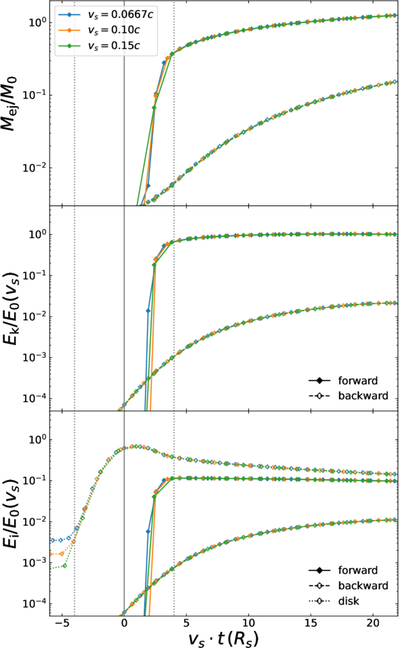
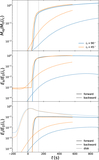
Caption: Figure 9.
Total ejecta mass and energy from star–disk collisions as a function of the distance dsd = vs · t between the star and the disk, for different impact velocities vs. Ejecta mass and energy are computed by integrating material located beyond 4Hd from the disk midplane, while the disk’s internal energy is calculated by integrating material within 4Hd to the disk midplane. From top to bottom, the panels show the ejecta mass, kinetic energy, and internal energy. Solid and dashed lines denote the forward and backward ejecta, respectively. The dotted lines in the bottom panel represent the internal energy for the disk.
Other Images in This Article
Show More
Copyright and Terms & Conditions
© 2026. The Author(s). Published by the American Astronomical Society.

