

Image Details
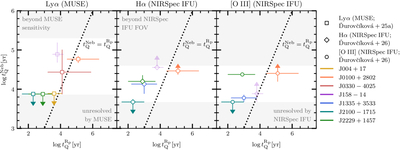
Caption: Figure 8.
Summary of nebular and proximity-zone lifetime constraints from this work (NIRSpec IFU, the middle panel displays Hα measurements, and the right panel displays [O III] measurements) and the literature (MUSE, left panel; D. Ďurovčíková et al. 2025a). The proximity-zone measurements are taken from A.-C. Eilers et al. (2018), F. B. Davies et al. (2020), and A.-C. Eilers et al. (2021), and in all three panels, we include the dashed 1:1 line to guide the eye. The gray shaded regions show regions that are either beyond the spatial resolution of the corresponding instrument or regions that are beyond detection due to the sensitivity or the field of view of the instrument. The faded, purple set of data points corresponds to J158–14, whose sight line has been found to be contaminated by a metal-poor absorption system (D. Ďurovčíková et al. 2025b), thereby truncating its proximity zone and causing a large discrepancy between its line-of-sight and transverse (nebular) lifetime measurements. All other data points confirm the existence of quasars with extremely short UV-luminous lifetimes at high redshifts.
Other Images in This Article
Copyright and Terms & Conditions
© 2026. The Author(s). Published by the American Astronomical Society.

