

Image Details
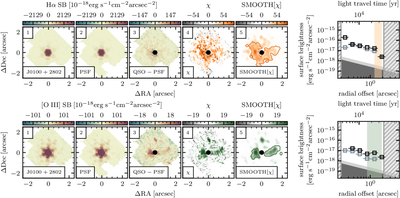
Caption: Figure 2.
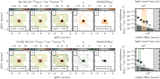
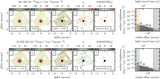
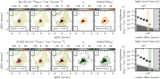
Results of our Hα (top row, orange color scheme) and [O III] (bottom row, green color scheme) nebular search for J0100+2802. Left column: From left to right, the panels display pseudo-narrowband images of (1) the data cube collapsed around the emission line in units of surface brightness, (2) the PSF extracted from the broad wings of the emission line, (3) the PSF-subtracted equivalent of panel (1), (4) the χ data, essentially representing the SNR of the PSF-subtracted data, and (5) the smoothed χ data showing the extended nebular emission. Panels (1), (3), (4), and (5) are collapsed across the wavelength range of the detected nebula, and panel (2) is collapsed across the wavelengths of the PSF extraction as displayed in Appendix B. White patches correspond to masked foregrounds/artifacts, and the black circle marks the position of the quasar. Right column: annulus-averaged surface brightness profiles extracted from panel (3), computed both using the full pseudo-narrowband image (gray data points) and only taking the nebular voxels (black data points) into account. The black data points are used to identify the maximum extent of the nebula, from which the lifetimes are derived. The noise floor (gray shaded regions corresponding to 1σ and 2σ) is extracted from the outermost annulus, excluding pixels identified as part of the nebula. Additionally, the hatched vertical regions mark the central region inaccessible due to PSF residuals, as well as the region that lies beyond the field of view of the NIRSpec IFU.
Other Images in This Article
Copyright and Terms & Conditions
© 2026. The Author(s). Published by the American Astronomical Society.

