

Image Details
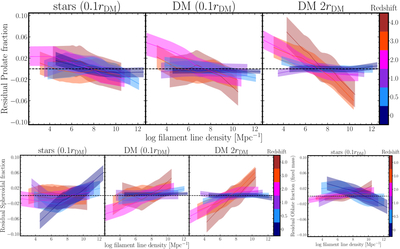
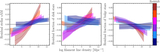
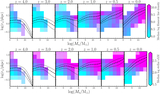
Caption: Figure 7.
Residual morphological fractions at fixed stellar mass, shown as functions of the nearest filament density. Each color is a different redshift, with the median and ±1σ uncertainties being represented by solid lines and the lighter shaded region, respectively. The top row presents the residual prolate fractions for stars, inner DM halo, and outer DM halo in the different columns. The bottom row presents the residual spheroidal fractions for stars, inner DM halo, and outer DM halo in the left three columns, and the residual oblate fraction of stars in the right column (DM halos are rarely oblate so we omit those panels for the residual oblate fraction). For stars, the residual prolate fraction is higher in low-density filaments at early times, and the residual spheroidal (oblate) fraction is higher in high-density (low-density) filaments at later times. For halos, the residual prolate fraction decreases and the spheroidal fraction increases with filament density at z > 1.
Other Images in This Article
Show More
Copyright and Terms & Conditions
© 2026. The Author(s). Published by the American Astronomical Society.

