

Image Details
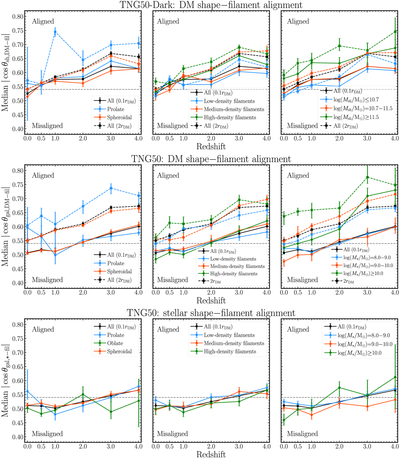
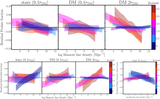
Caption: Figure 2.
Redshift evolution of the median angle of alignment (and ±1σ bootstrapped errors) between the major axis of galaxies/subhalos and the direction of the nearest filament segment, in the DM-only TNG50-Dark (top row) and the hydrodynamic TNG50 (middle and bottom rows) simulations. Dashed lines and square markers represent the alignment at 2rDM (outer halos), while solid lines and circles represent alignment at 0.1rDM (inner halo). The left, middle, and right columns subdivide subhalos/galaxies by 3D shape, line density of nearest filament segment, and mass, respectively. The dashed horizontal line represents no preferential shape alignment. DM shape–filament alignments are down to at least z ∼ 2 in TNG50 and z ∼ 0.5 in TNG50-Dark, but stellar shape–filament alignment disappears at z < 4 and tends toward misalignment at z ≤ 2. At the outer halo scale, prolate halos, massive halos, and halos near high-density filaments show the strongest shape alignments. The inner halo shapes are less aligned in the baryonic than in the DM-only simulation.
Other Images in This Article
Show More
Copyright and Terms & Conditions
© 2026. The Author(s). Published by the American Astronomical Society.

