

Image Details
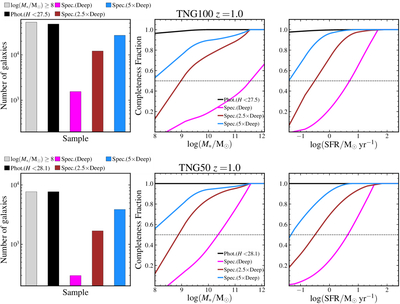
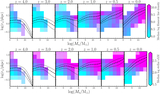
Caption: Figure 10.
Properties of different galaxy samples at z = 1 in TNG100 (top row; comparable to the size of HLWAS-Deep) and TNG50 (bottom row; comparable to HLWAS-Ultra deep). The samples are as follows: gray = full sample of ﹩{\mathrm{log}}\,({M}_{* }/{M}_{\odot })\,\geqslant \,8﹩ galaxies; black = photometric sample with mock H-band magnitude mH < 27.5 (top) and mH < 28.1 (bottom); magenta, brown, and blue = samples satisfying both the photometric cut and a minimum SFR cut from spectroscopic emission line flux limits corresponding to 1×, 2.5×, and 5× the depth of HLWAS-Deep, respectively. Left: total number of galaxies in a given sample. Middle and right: completeness fraction as a function of mass and SFR. Very deep spectroscopy is needed to obtain fairly complete galaxy samples with which to trace the cosmic web.
Other Images in This Article
Show More
Copyright and Terms & Conditions
© 2026. The Author(s). Published by the American Astronomical Society.

