

Image Details
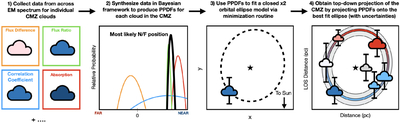
Caption: Figure 1.
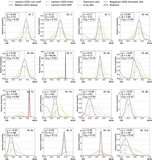
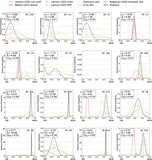
We present a method to synthesize multiwavelength datasets to obtain most likely near/far positions of clouds in the CMZ and find a best-fitting elliptical orbit. Our methodology follows the above schematic from left to right: (1) we collect both near/far and line-of-sight distance constraints from a variety of methods across the electromagnetic spectrum (Section 2), (2) we build a Bayesian framework to combine these different data on a normalized near-to-far scale, producing positional probability density functions that peak at the most likely position of a given cloud (Section 3.1), (3) we find a best-fitting closed elliptical x2 orbit using each cloud’s PPV location and NF distribution (Section 3.2), and (4) we use the best-fit orbital model to present a preliminary top-down projection of the CMZ with line-of-sight distance estimates for all CMZ clouds (Section 4.3). The black star in panels (3) and (4) indicates the location of SgrA⋆. The blue and red colors of clouds in panels (3) and (4) indicate likely near or far positions, respectively.
Other Images in This Article
Show More
Copyright and Terms & Conditions
© 2026. The Author(s). Published by the American Astronomical Society.

