

Image Details
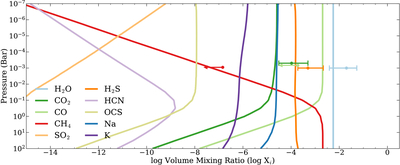
Caption: Figure 6.
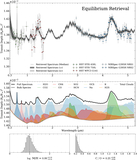
Comparison between the equilibrium chemical profiles and free chemistry VMRs inferred via our POSEIDON retrieval analysis. We plot as the colored lines the equilibrium chemistry VMRs as a function of pressure, and as colored points the corresponding VMRs from our free retrieval. We plot error bars to represent the 1σ upper and lower bounds for H2O, CO2, and H2S, whereas we plot left-pointing arrows to represent the 2σ upper limits for CO and CH4. While our equilibrium chemistry retrieval prefers a low C/O ratio that approaches the lower end of the prior range in conjunction with cloud-muted features, our free retrieval instead prefers a low computed C/O ratio of 0.006 with patchy cloud coverage. This value is calculated from the stoichiometric sum of the freely retrieved molecular VMRs and is not the equilibrium-retrieval C/O posterior shown in Figure 4; because CO is not constrained, the free-retrieval value should not be interpreted as a robust elemental abundance ratio. The discrepancy between our equilibrium and free chemistry retrievals indicates that disequilibrium chemistry is affecting HAT-P-1 b’s atmosphere, rendering equilibrium chemical retrievals inadequate for the purpose of estimating the planet’s atmospheric properties.
Other Images in This Article
Copyright and Terms & Conditions
© 2026. The Author(s). Published by the American Astronomical Society.

