

Image Details
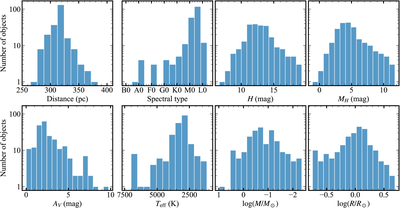
Caption: Figure 2.
Distributions of stellar parameters for IC 348 members in our broader sample, 200 of which have reliable Hα photometry. Panels show Gaia EDR3-based distances (C. A. L. Bailer-Jones et al. 2021), spectral types compiled by K. L. Luhman et al. (2016), apparent H-band magnitudes (H), absolute H-band magnitudes (MH), line-of-sight extinctions (AV), effective temperatures (Teff), evolutionary-model-inferred masses, and radii. The distance estimates for individual members span ∼270–370 pc with a median of 312 pc and standard deviation of 14 pc. This spread is dominated by measurement uncertainty rather than the intrinsic depth of IC 348. We therefore adopt the weighted mean cluster distance of 316.3 ± 0.5 pc, as discussed in Section 3.2. Absolute H-band magnitudes are obtained by correcting the observed H-band magnitudes for extinction and then applying the distance modulus. Spectral types extend from mid-B to early L dwarfs and are strongly skewed toward M types. The inferred Teff values span ∼1000–7000 K. The evolutionary-model masses cover the stellar-to-planetary mass regime, from ∼10 MJup up to ∼9 M⊙.
Other Images in This Article
Show More
Copyright and Terms & Conditions
© 2026. The Author(s). Published by the American Astronomical Society.

